
Caswell County Clerk of Superior Court
The Clerk of Superior Court is the primary court-record custodian for Caswell County. The research names John Satterfield as Clerk of Superior Court. The office is located at the Caswell County Courthouse, 139 East Church Street, Yanceyville, NC 27379. The North Carolina Judicial Branch lists the courthouse mailing address as Caswell County Courthouse, PO Drawer 790, Yanceyville, NC 27379. The clerk's phone number is (336) 459-4000, and courthouse hours are Monday through Friday, 8:30 a.m. to 5:00 p.m.
North Carolina law gives the clerk a broader role than a filing counter. N.C.G.S. 7A-109 requires clerks to maintain court records, files, dockets, and indexes prescribed by the Director of the Administrative Office of the Courts, and it makes those records open to public inspection during regular office hours except where law bars access. The Clerk of Superior Court is also central to estates and special proceedings, which makes the office important for civil, criminal, family, probate, judgment, and copy questions.
Caswell County Clerk of Superior Court
Clerk: John Satterfield
Caswell County Courthouse
139 East Church Street
Yanceyville, NC 27379
Mailing: PO Drawer 790, Yanceyville, NC 27379
(336) 459-4000
Monday-Friday 8:30 a.m.-5:00 p.m.
What Clerk of Superior Court Records Include
The Clerk of Superior Court handles Superior Court, District Court, criminal cases, civil cases, estates, special proceedings, judgments, and court-file copy requests. The office also handles divorce judgment copies when the divorce was granted in Caswell County. Court audio-recording requests, certified criminal record searches, and paper case file inspection all route through clerk channels when the file is local to Caswell County.
- Court files, dockets, indexes, orders, judgments, and case documents for Caswell County trial court matters.
- Criminal and civil case information available by Portal, public terminal, or paper file request.
- Estates, guardianship, special proceedings, and other clerk-administered court matters.
- Certified criminal record searches using the official single-county background check process.
- Divorce judgment copy requests for divorces granted in Caswell County.
- Audio recording requests when a hearing was recorded and the record is not confidential.
The Clerk of Superior Court should not be confused with the Register of Deeds. The Register of Deeds handles deeds, deeds of trust, maps, military discharge records, notary records, birth certificates, death certificates, and marriage licenses. The sheriff's records division is also separate and handles incident reports, arrest reports, inmate or jail information, civil process data entry, jury notices and summons processing, and deputy court-schedule coordination.
Request Caswell County Certified Copies
Certified copies are needed when a court record must carry official certification from the clerk. The research does not locate a single Caswell-specific copy request form for every court document, so requests should include enough file information for clerk staff to identify the record. Case number, party names, case type, document name, filing date, and the number of copies requested are useful. If the requested record is a divorce judgment, state that the divorce was granted in Caswell County and ask for a copy of the judgment rather than a marriage or vital certificate.
- Identify the case number through the eCourts Portal, a hearing notice, a prior court document, or a public terminal.
- Contact or visit the Caswell County Clerk of Superior Court at the courthouse for the local case file.
- State the document needed, such as judgment, order, estate filing, divorce judgment, or certified criminal record search.
- Provide party names, file date or approximate year, and contact information so staff can match the request.
- Pay the required fee or ask the clerk for the current amount when the research did not locate a Caswell-specific fee.
Note: Portal case information is useful for locating a file, but it is not the same as a certified copy issued by the clerk.
Clerk of Superior Court Request Fields
Three official request routes are documented in the research: the certified criminal record search, the nonconfidential audio recording request, and the confidential audio recording request. Ordinary paper copy requests are handled by the clerk for a fee, but no Caswell-specific universal request form was located. The table below uses the documented forms and practical file identifiers that the clerk needs to match a record.
| Request Field | Required | Notes |
|---|---|---|
| Case number or record number | Helpful when available | Portal and court notices may provide the number used by clerk staff. |
| Party names | Yes | Use defendant, plaintiff, petitioner, respondent, decedent, or estate names as appropriate. |
| Record type | Yes | Examples include judgment, order, divorce judgment, estate file, audio recording, or certified background search. |
| County searched | Yes for certified criminal search | AOC-CR-314 is a single-county certified criminal record search. |
| Requester contact details | Yes | Needed for pickup, mailing, payment, or follow-up questions. |
| Confidential-case permission | Conditional | AOC-G-115 requires court permission for confidential audio recordings. |
Clerk of Superior Court Fees
Only some clerk-related fees were confirmed in the research. The North Carolina Judicial Branch criminal background check topic gives a $25 fee for a single-county certified criminal record search. Mail requests require money order or certified check. In-person requests may be paid by credit card, cash, money order, or certified check, and personal checks are not accepted for that request. Court document copies, divorce judgment copies, and audio recording copies may also have fees, but the exact Caswell court-copy amounts were not located in the assigned sources.
| Item | Amount or Payment Note |
|---|---|
| Certified criminal record search, single county | $25 |
| Certified criminal search by mail | Money order or certified check required |
| Certified criminal search in person | Credit card, cash, money order, or certified check accepted |
| Court document copies | Fee applies, exact Caswell amount not located |
| Divorce judgment copy | Fee applies through clerk, exact Caswell amount not located |
| Audio recording CD | Actual cost of CD if recording is available |
The Caswell Register of Deeds disclaimer and redaction notice is not a clerk fee source, but it is assigned to the clerk record set because it explains public-record image limits and personal identifier redaction for records outside the court file.
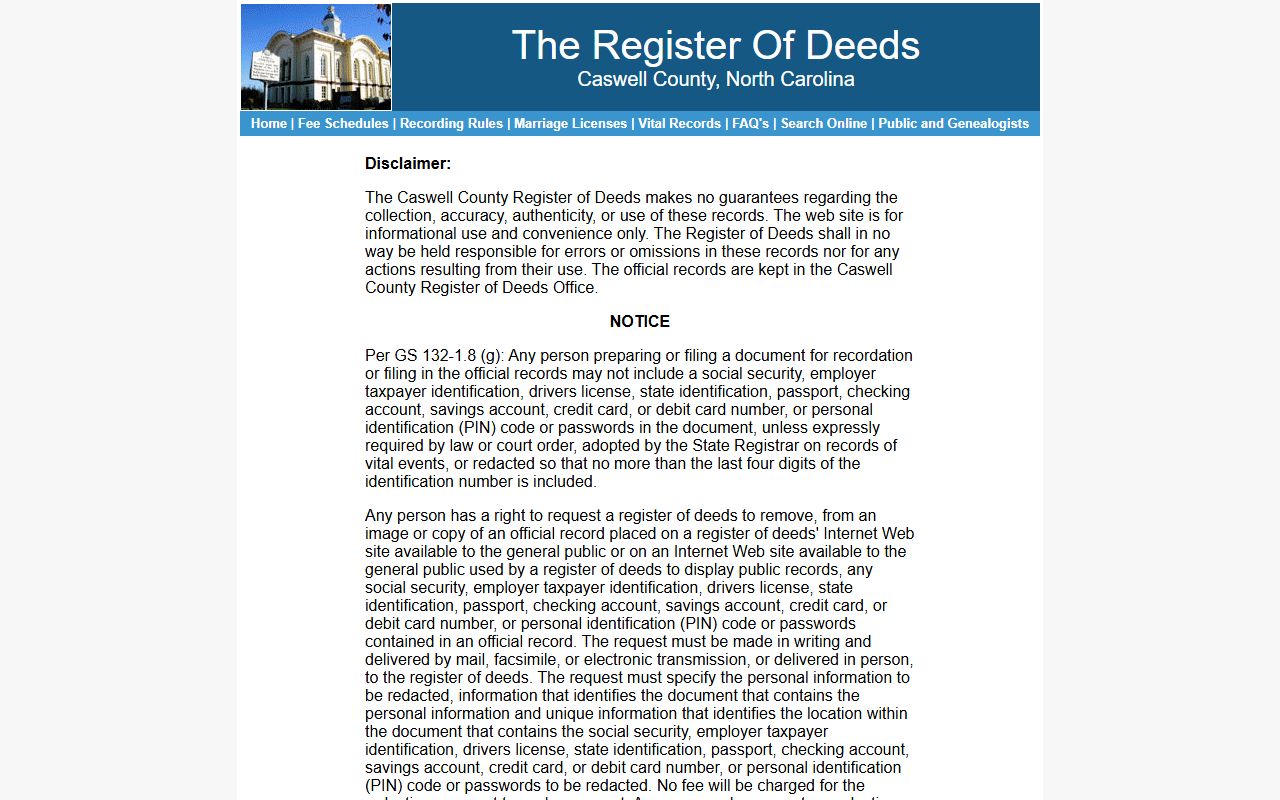
That source is useful when a person is deciding whether a record belongs with the Clerk of Superior Court or the Register of Deeds.
Common Clerk of Superior Court Forms
The assigned research identifies three form routes tied to clerk record access. AOC-CR-314 is the certified criminal background check request. AOC-G-114 is used to request nonconfidential audio recordings when a proceeding was recorded by a clerk or digital recording technician. AOC-G-115 is used for confidential audio recording requests, and the request requires court permission in confidential case types such as juvenile and involuntary hospitalization matters.
| Form or Request | Use | Submission Rule |
|---|---|---|
| AOC-CR-314 | Certified single-county criminal record search | Submit to the Clerk of Superior Court with the $25 fee. |
| AOC-G-114 | Nonconfidential audio recording request | Submit to the clerk in the county where the case is filed. |
| AOC-G-115 | Confidential audio recording request | Requires court permission before access. |
| Paper file copy request | Civil, criminal, estate, special proceeding, or divorce judgment copies | Request from clerk staff in the county where the case is located. |
Online and In-Person Clerk Access
Caswell County case information can be searched online through the eCourts Portal Smart Search. The Portal can search records and case information, but it requires JavaScript and cookies and uses a CAPTCHA challenge at intervals. Some document access may require registered or elevated access. Public terminals in clerk offices can be used for criminal, civil, special proceeding, and estates case information, and criminal terminal searches may use defendant name, case number, or victim and witness name.
Paper case files are inspected in the clerk's office in the county where the case is located. Older matters, sealed matters, expunged matters, juvenile cases, involuntary hospitalization records, and confidential filings may not be fully visible online. For administrative Judicial Branch public records, North Carolina provides a separate public-record request pathway, but ordinary court case-file requests are usually handled through the clerk office, Portal, or public terminal.
Federal records are separate. The manifest includes the U.S. Bankruptcy Court for the Middle District of North Carolina because bankruptcy cases are not Caswell County Clerk of Superior Court records.
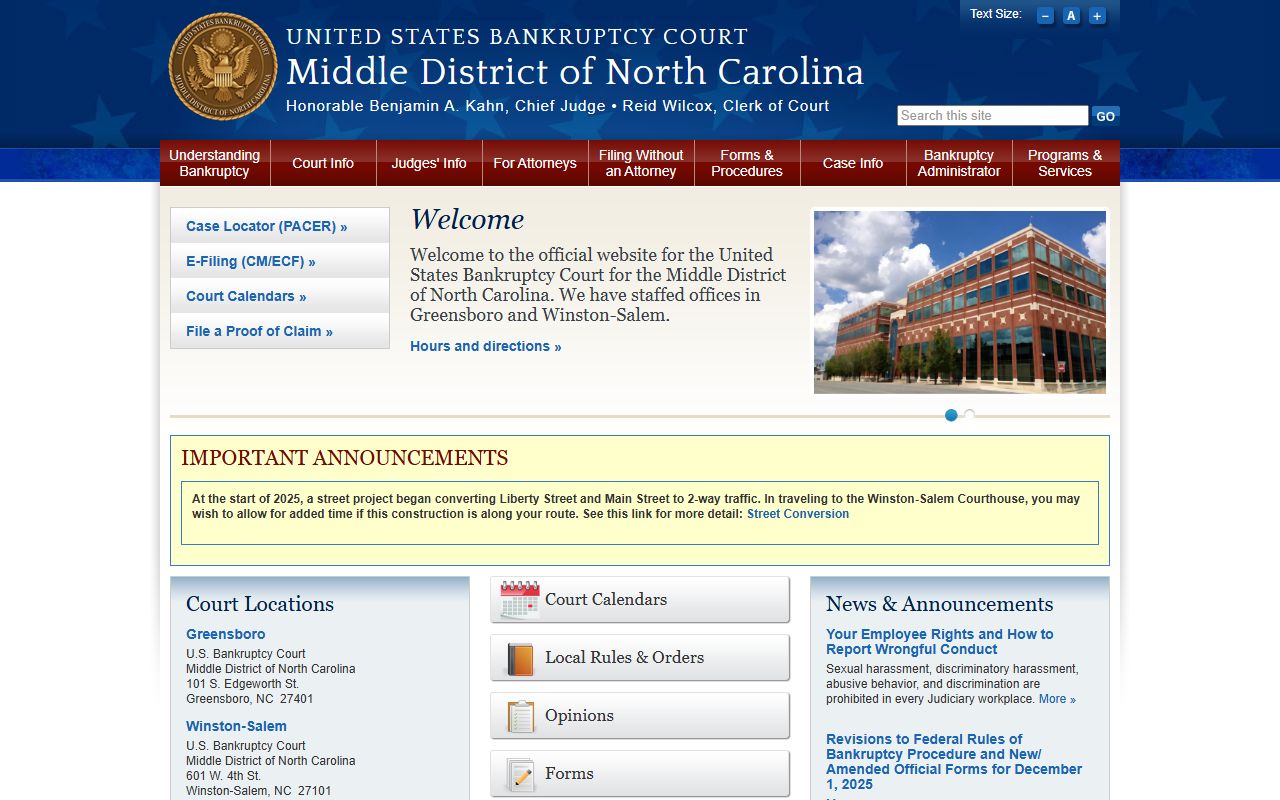
Bankruptcy, federal district court, and federal appellate files use federal systems, while Caswell County Superior Court and District Court files remain with the state clerk structure.
Restricted Clerk of Superior Court Records
Public access is broad, but not absolute. Juvenile records under Chapter 7B are confidential or limited access. Sealed and expunged criminal records should not be treated as missing just because they do not appear in a public search. Adoption records are confidential. Involuntary hospitalization and some mental health proceedings are confidential. Files involving minors, protected addresses, financial account numbers, Social Security numbers, and other personal identifiers may be redacted before public release.
Expunction requests are filed under the correct North Carolina statute in the county where the charge or conviction occurred, usually through the Clerk of Superior Court. North Carolina has several expunction statutes, so eligibility depends on the exact charge, disposition, prior record, waiting period, and statutory exclusions. A public Portal search is not proof that expunction is available or complete. The clerk can identify filing routes, but legal advice and eligibility decisions may require counsel or a court ruling.