
Caswell County Arrest Records and Charges
Arrest records and court charge records are related, but they are not the same file. The arrest side is tied to law enforcement activity, booking information, incident or arrest reports, and the detention process. The court charge side starts when a criminal accusation is filed or carried into court through a citation, warrant, magistrate order, criminal summons, indictment, or related process. Court charges after arrest then move through hearings, pleas, dismissals, amendments, dispositions, and sentencing.
The Caswell County sheriff page identifies Sheriff Tony Durden and points users to sheriff services, detention, and permit information.
The sheriff source is useful for the arrest-record side, while the court file is needed to confirm what charges were actually filed and how each charge changed.
Arrest Records vs Court Charges
An arrest record may show that an officer took a person into custody or created a report after an incident. It can connect to a booking, detention hold, warrant, citation, or law enforcement case number. A court charge record is narrower and more formal: it shows the allegation that entered the court system and the charge status as the case moves. For custody and jail-list details, use the Caswell County inmate records path.
| Point | Arrest Record | Court Charge Record |
|---|---|---|
| Primary Source | Sheriff or law enforcement records. | Clerk and court case records. |
| Main Event | Custody, booking, incident report, citation, or arrest process. | Formal allegation filed into the court case. |
| Key Fields | Name, arrest date, agency, booking link, report type, or detention reference when public. | Charge, statute, count, case number, court level, status, plea, disposition, and sentence. |
| Best Use | Confirm the law enforcement contact or booking path. | Confirm what the court is actually prosecuting and how the charge ended. |
Find Caswell County Arrest Records
The best search path depends on the part of the record being checked. Court charges after arrest can be searched in eCourts Portal Smart Search by defendant name or case number, with Caswell County selected as the location. Arrest or incident report questions should go to sheriff records channels. The sheriff administration and records division research notes arrest and incident reports, domestic violence orders, and coordination with court schedules.
- For court charges, search Smart Search by name or case number and filter to Caswell County.
- Open the criminal case and read each charge, status, hearing, disposition, and financial obligation.
- For arrest or incident reports, use the sheriff records contact path rather than the court case portal.
- For custody or jail status, check the separate inmate-record route instead of assuming the court charge page has booking data.
- For certified criminal-history use, request the clerk's single-county certified search rather than relying on a public Portal match.
The Sheriff Administration page is the assigned source for records-division duties tied to arrest and incident reports.
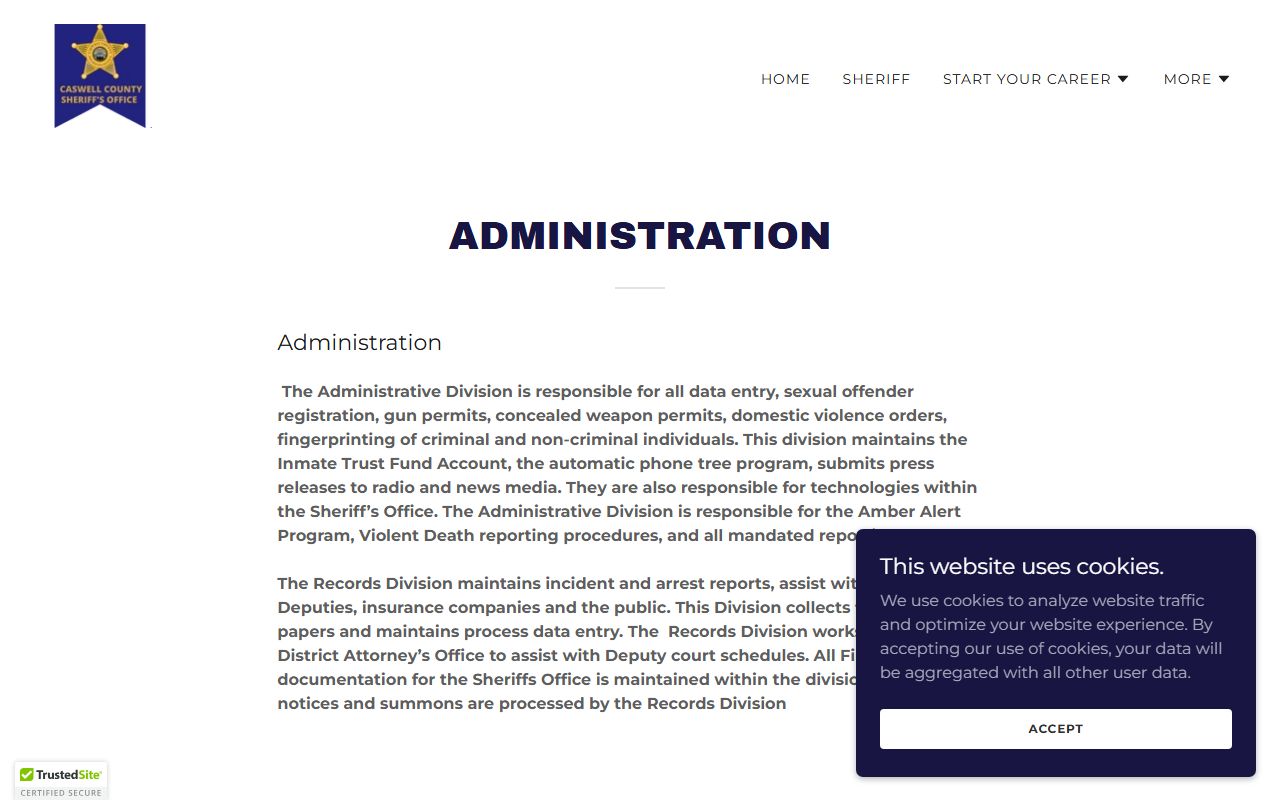
That sheriff records channel fills the gap when the needed information is an arrest report or incident report rather than a court charge entry.
Charges Filed After a Caswell Arrest
North Carolina case records in the research identify warrants, magistrate orders, citations, indictments, criminal summonses, pleadings, bond orders, and court dates as criminal record materials. The common complaint, information, and indictment labels should be read through that North Carolina context. In Caswell County, the visible record may use the state document name rather than a generic label from another state.
| Charging Path | North Carolina Record Names Found in Research | What It Does |
|---|---|---|
| Complaint-style process | Warrant, magistrate order, citation, or criminal summons | Starts or carries a criminal accusation into court after officer or magistrate action. |
| Prosecutor-filed charge path | Pleadings, amended charges, reductions, dismissals, or case events | Shows how the District Attorney handles the accusation after it enters court. |
| Indictment | Formal felony charging document returned by a grand jury | Moves serious felony allegations through Superior Court. |
Caswell Court Charge Status
A charge can change after the first court entry. It may remain pending, be amended, be reduced, be dismissed, or end in a conviction after a plea or verdict. The District Attorney's role begins after law enforcement charging and affects prosecution, plea offers, dismissals, reductions, and trial. Kathryn Gregg is the current District Attorney for Prosecutorial District 22, which covers Caswell and Rockingham counties.
| Status | What It Means in a Court Charge Record |
|---|---|
| Pending | The charge is still active and has not reached a final disposition. |
| Amended | The charge description, statute, count, or level changed during the case. |
| Reduced | The prosecution or court resolved the matter at a lower offense level or different offense. |
| Dismissed | The court record shows the charge did not proceed to conviction. |
| Convicted | The record shows a guilty plea, verdict, or other finding that supports sentencing. |
Charges vs Convictions
Being charged is not the same as being convicted. A person can have a visible court charge after arrest even if the charge is later dismissed or reduced. Read the disposition and sentence fields before treating a charge as a final result. A full case outcome belongs with the Caswell County criminal court records file.
| Point | Charge | Conviction |
|---|---|---|
| Stage | Allegation filed in court. | Final guilt or responsibility result after plea, finding, or verdict. |
| Record Meaning | Shows what was accused, not what was proved. | Shows the court outcome that may support punishment. |
| Possible Change | Can be amended, reduced, dismissed, or tried. | Can lead to sentencing, probation, fines, costs, or restitution. |
| Search Caution | Needs the docket and disposition to understand. | Needs sentence terms and any later compliance entries. |
Statewide Arrest and Charge Context
Some statewide tools are related to criminal justice records, but they do not replace a Caswell County court charge search. A sex offender registry, offender search, or correctional database may reflect later status, supervision, or registry requirements. Those records are not the same as the court's charge list for a pending or closed criminal case.
The North Carolina sex offender registry is linked by the sheriff as a public state resource.
Registry results should be read as a separate public-safety record, not as a complete list of Caswell County arrest records or court charges.
DA and Defense Roles
The District Attorney represents the State in criminal and juvenile prosecutions. The DA supervises assistant district attorneys, legal assistants, investigators, and administrative staff. Prosecutors decide how to proceed on charges, which can affect reductions, dismissals, plea offers, and trial settings. The Caswell contact directory lists a courthouse District Attorney number, and the district DA page lists the main district office in Wentworth.
NC Indigent Defense Services reports public defense through local public defender offices, contract attorneys, and judicial appointment of private assigned counsel. Research did not locate a dedicated Caswell public defender office. Caswell appears to rely on appointed or IDS-managed counsel unless another local office is assigned.
The NC IDS Caswell County page is the county-specific public defense source.
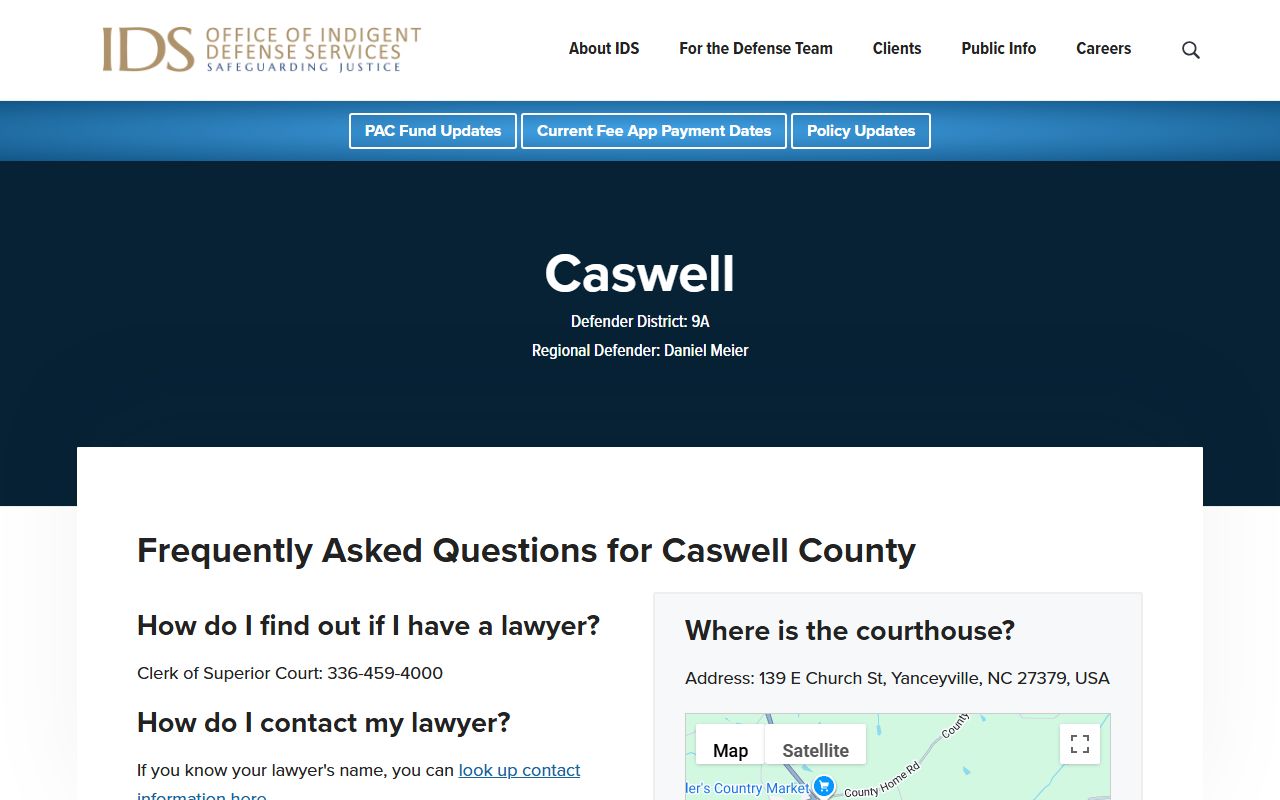
Defense counsel information matters because charge negotiations, pleas, and court settings can change what the court charge record shows.
Caswell Public Defense Access
The NC IDS statewide map explains how public defense is organized across North Carolina.
That statewide map helps place Caswell County charge cases within the broader appointed-counsel system when a defendant qualifies for indigent defense.
Restricted Caswell Arrest Records
Not every arrest or charge record is public in the same way. Juvenile records are restricted under Chapter 7B. Sealed and expunged matters should not be treated as complete Portal results. Adoption and certain mental health proceedings are confidential. Personal identifiers can be redacted from public copies. A public search may also omit documents that require court permission, clerk review, or elevated access.
Expunction is a legal process that can remove, seal, destroy, or limit records of an arrest, charge, or conviction. North Carolina has multiple expunction statutes, and eligibility turns on the exact charge, disposition, prior record, waiting period, and exclusions. A visible arrest or charge is not the same as a conviction, and a missing public result is not proof that no restricted record ever existed.
Important: Certified criminal-history and legal-copy needs should go through the Clerk of Superior Court, not a casual public search.